Showing posts with label Christianity. Show all posts

Thursday, April 2, 2026

Flowers in Scripture That Refer to (or Symbolically Foreshadow) Jesus Christ 🌸

Spring is the time of the year for flowers, and in particular, the months of March and April celebrate Jesus Christ and His sacrifice for humanity.  The Bible contains many flowers and images of flowers that are used directly or symbolically in connection with Jesus Christ.  Behold the beauty of Christ.

lily

1. Lily

Biblical references:
Song of Solomon 2:1–2; Hosea 14:5; Matthew 6:28–29

Connection to Christ:
In Song of Solomon, the beloved is compared to a lily. While the original context is romantic poetry, Christian interpretation has often seen the Bridegroom as a type of Christ. In Hosea 14:5, God says of restored Israel, “He shall blossom like the lily,” which many Christians read as pointing to the Messiah’s purity and beauty. Jesus Himself references lilies when teaching about God’s provision, which believers connect to His own divine care.

Symbolic themes: purity, beauty, divine provision.

rose

2. Rose / Rose of Sharon

Biblical reference:
Song of Solomon 2:1

Connection to Christ:
The text says, “I am the rose of Sharon,” spoken by the bride or bridegroom, depending on interpretation. Christian theology has historically applied this to Christ as the fairest, most beloved, and most fragrant among God’s people.

Symbolic themes: loveliness, uniqueness, the beauty of the Messiah.

almond blossom

Flowering Plants or Blossoms Used as Messianic Imagery

These are not always “flowers” in the modern gardening sense, but Scripture uses imagery of blossoming and botany to describe the Messiah.

3. The Branch That Blossoms

Biblical references:
Isaiah 11:1; Jeremiah 23:5; Zechariah 6:12

Connection to Christ:
These are explicit messianic prophecies fulfilled in Jesus. While they do not name a specific flower, the imagery is botanical and often pictured as a flowering branch. Jesus is the righteous Branch from the line of David and Jesse.

Symbolic themes: new life, kingship, restoration.

4. Almond Blossom

Biblical reference:
Numbers 17:8

Connection to Christ:
Aaron’s rod miraculously “sprouted, put forth buds, produced blossoms, and bore ripe almonds.” Early Christian readers saw this as a type of Christ’s resurrection—life springing from what was dead. Almond blossoms also appear in the design of the lampstand (Exodus 25), which many connect to Christ as the Light of the World.

Symbolic themes: resurrection, priesthood, divine election.

5. Blossoms on the Vine

Biblical reference:
John 15:1

Connection to Christ:
Jesus says, “I am the true vine.” While the passage does not explicitly mention flowers, a vine naturally produces blossoms before fruit. The image emphasizes that all true spiritual life and fruitfulness flow from union with Christ.

Symbolic themes: spiritual life, fruitfulness, union with Christ.

Summary

Category Flower / Plant Scriptural Basis Connection to Christ
Direct floral imagery Lily Song 2:1–2; Hosea 14:5; Matthew 6:28–29 Purity, beauty, divine care
Direct floral imagery Rose / Rose of Sharon Song 2:1 Beauty, belovedness
Flowering prophetic imagery Branch (blossoming) Isaiah 11:1; Jeremiah 23:5; Zechariah 6:12 Messiah, kingship, restoration
Flowering prophetic imagery Almond blossom Numbers 17:8 Resurrection, priesthood
Botanical metaphor Vine (implied blossoms) John 15:1 Life-giving union and fruitfulness in Christ

ADDITIONAL REFERENCES:

  • Brown, Raymond E. The Birth of the Messiah. Doubleday, 1993.
  • Keener, Craig S. The IVP Bible Background Commentary: New Testament. InterVarsity Press, 1993.
  • Ryken, Leland, et al., editors. Dictionary of Biblical Imagery. InterVarsity Press, 1998.
  • Wright, N. T. Jesus and the Victory of God. Fortress Press, 1996.

Thank you for visiting. B.O.B. (Blessings on Blessings.)🌸 

Sunday, March 29, 2026

Christianity: Symbolism of the Palm Tree in Scripture

The palm tree carries deep symbolic meaning throughout the Bible, and many of its themes point beautifully to Jesus Christ and the life He gives.

palm trees

1. Righteousness and Flourishing

Key verse: “The righteous shall flourish like the palm tree.” — Psalm 92:12

The palm stands tall, straight, and evergreen, symbolizing enduring righteousness. Christ, the perfectly righteous One, fulfills this image completely. Believers flourish in Him just as a palm thrives even in harsh conditions.

Themes: steadfastness, purity, spiritual vitality.

2. Victory and Triumph

In the ancient world, palms symbolized victory and were awarded to champions.

Connection to Christ: When Jesus entered Jerusalem, the crowds waved palm branches (John 12:13), proclaiming Him as the victorious King.

Themes: kingship, triumph, messianic identity.

3. Peace and Welcome

Palm branches were used in celebrations and joyful processions. When the people laid palms before Jesus, they offered Him honor, peace, and a warm welcome.

Themes: hospitality, joy, celebration of the Messiah.

4. Fruitfulness in Harsh Conditions

The date palm thrives in desert climates by drawing water from deep underground. This makes it a symbol of life in barren places—a fitting picture of Christ bringing life where there is spiritual dryness.

Themes: provision, sustenance, life-giving presence.

5. Uprightness and Integrity

The palm grows straight upward, unlike many trees that twist or bend. This became a symbol of moral uprightness, ultimately fulfilled in Christ, the One without sin.

Themes: holiness, moral clarity, divine perfection.

6. Resurrection and Eternal Life

Because palms remain green year-round and can live for centuries, they became symbols of immortality. Early Christians used palm imagery on tombs to proclaim the resurrection hope found in Christ.

Themes: eternal life, resurrection, hope beyond death.

7. Heavenly Worship

In Revelation, the redeemed stand before the throne with palm branches (Revelation 7:9). This echoes Jesus’ triumphal entry—now with His victory fully realized.

Themes: worship, final victory, redeemed humanity.

hosanna


Sources:

  • Ryken, Leland, et al., editors. Dictionary of Biblical Imagery. InterVarsity Press, 1998.
  • Keener, Craig S. The IVP Bible Background Commentary: New Testament. InterVarsity Press, 1993.
  • Wright, N. T. Jesus and the Victory of God. Fortress Press, 1996.

🌴🌴🌴🌴🌴🌴🌴

ADDITIONAL INFORMATION:

  • My original content republished from: Treathyl Fox aka cmoneyspinner, “Trees Deserve Respect.” Wizzley.Com, 25 Jul. 2013.

PALM TREES

Palmae Family

The Arabs say that "The palm tree has 360 uses".  Sorry.  I don't have the list to share with you.  But I will share what I know. 

In ancient times and perhaps even today, the branch from a palm tree symbolized peace and victory, success, or celebration. Palm trees are very easy to recognize.  They are tall, slender, with no branches.  Instead of branches, on top of the trunk is a crown of spreading plumes. 

Most people associate palms swaying in the breeze with a tropical environment like Florida or The Bahamas.

While others think of the date palm tree that grows in the Middle East.  Its fruit is part of the daily diet of millions of people.  The date can be eaten fresh or dried; incorporated as a key ingredient in a myriad of recipes; and the tree sap can be made into syrup or wine.  Jericho, which is in the Jordan Valley, has a tropical climate, and is known for its lush palm groves.  Once it has reached maturity, this tree can yield fruit for 100 years. 

Wherever they grow, if you see a palm tree, breeze or no breeze, it is hard not to be captivated by its striking beauty.

Learn more:  How to Identify Species of Palm Trees


Thank you for visiting. B.O.B. (Blessings on Blessings.)🌴


Tuesday, January 27, 2026

Paul the Apostle Knew His Friends: TITUS

Titus was a Grecian convert. Luke does not mention him by name in the Book of Acts, but Paul confirms him as a “partner and fellow helper”. Titus accompanied Paul and Barnabas on a trip to Jerusalem. Unable to go for himself, Paul sent Titus to work with the congregation in Corinth, and then bring back news about their well-being and spiritual health. He brought back a good report and refreshed the weary Apostle's spirit. Several years later, Paul would leave Titus behind in Crete to build up the Church there.

Image credit: Magic Studio AI art Generator


The relationship between Paul and Titus was much like to his association with Timothy. The two letters to Timothy and the letter to Titus have been grouped together and referred to as Pastoral Epistles. Both men were directed to ordain elders to oversee the flock of God, warned about false teachers, told to maintain good works, the purity of the Church, and especially ensure their own personal morality and blameless reputation as godly men.

The last reference to this young preacher is Paul's mention of him in a letter to Timothy (whom he had left in Ephesus) that Titus was headed to Dalmatia (conquered by the Romans A.D. 12; today a region of Croatia, Yugoslavia).


Excerpt of content first published at Paul and Friends | HubPages


Paul the Apostle Knew His Friends: TIMOTHY (or TIMOTHEUS)

Timothy was called Paul's son in the gospel.  Timothy's mother (Eunice) and grandmother (Lois) were devout Jews who taught him the Jewish scriptures from a child. All three of them were converted to Christianity. This young man traveled with Paul to places where he was sent by Paul – such as Berea, Macedonia, Thessalonica, Corinth, and Philippi – to evangelize, preach, teach, comfort, and assure the believers to press on and not falter. Paul was retracing his steps and revisiting Lystra in Lycaonia when he and Timothy crossed paths. The first time he was in this small city was with Barnabas. On this second trip, Timothy joined Paul's company.

Image credit: Magic Studio AI art Generator


Paul commended his young companion as follows (paraphrased): “We have the same mind. He does not seek his own. He has served with me in the gospel and has the same boldness to as I do to defend the faith. His love and care for all the churches is genuine.”

While in prison in Rome, awaiting execution, the Apostle wrote to Timothy instructing him to persevere and continue the Lord's work without him.


Excerpt of content first published at Paul and Friends | HubPages


Paul the Apostle Knew His Friends: LUKE (or LUCAS)

The name Lucas means “light-giving”. Very appropriate since he authored a two-part work – the Gospel of Luke and the Acts of the Apostles – both written to shed light on the life of Christ and the establishment of His Church.


His first appearance, historically, is in Troas. Details about his conversion are unknown. Details regarding his faithfulness are made plain in the New Testament scriptures. Luke traveled with the Apostle during his second (from Troas to Philippi), third (from Philippi to Jerusalem), and final (from Jerusalem to Rome) missionary journeys. In addition, during one of Paul's imprisonments, Luke dutifully remained close by. Luke was an educated man; writer, historian, and physician by profession. Paul speaks of him with great affection as the “beloved physician”.

Paul the Apostle knew his enemies. But he kept his friends closer.
During his final hours, Luke was the only one with him.  (2 Timothy 4:11)


Excerpt of content first published at Paul and Friends | HubPages


Paul the Apostle Knew His Friends: BARNABAS

Barnabas was Paul's champion. While others may have doubted the sincerity of the Apostle's conversion, Barnabas sought Paul out. When he found him in Tarsus, he encouraged him to become a fellow laborer and convinced others that he could be an invaluable help with the missionary efforts.

Image credit: AI Generated - DeviantArt


The disciples were called Christians* first in Antioch.” (Acts 11: 26) Barnabas and Paul traveled together to Antioch in Syria to strengthen the community of believers already there. The zealous teamwork of these two men proved very successful. Though the Church began, A.D. 33, in Jerusalem, from Antioch the “good news” would spread to all the major cities in the Roman Empire, including Rome.

Before becoming a Christian, Barnabas was a Jew; a Levite from the island of Cyprus, whose name was Joseph (Joses). He was called “son of consolation (or encouragement)” by the disciples because he had a gift for motivating those who were discouraged to remain focused, steadfast, and faithful. So committed was he that he sold his property and donated the proceeds to help the poor and needy. His act of generosity spurred others on to perform similar good works.

* Greek: Christianoi: “devotees of the Anointed One.


The Apostle Paul's other companions: 

Luke

Timothy

Titus

Clement


Excerpt of content first published at Paul and Friends | HubPages


Saturday, December 6, 2025

Bethlehem Through the Ages: 15 Wonder-Filled Facts From the Bible and History

Bethlehem is one of the most recognizable towns in the world — yet few people know its deep, layered story that begins long before the Nativity and stretches into modern times. Below is a time-travel view of Bethlehem: what it was like before Jesus, during His life, and throughout the centuries that followed.

Bethlehem
Image by Arnie Bragg from Pixabay

⭐Before Jesus: Bethlehem in the Old Testament

1. Bethlehem Was Once Called Ephrath or Ephrathah

Genesis refers to the town as Ephrath when Rachel dies there. This highlights its deep antiquity. The name “Bethlehem Ephrathah” emphasizes its ancient identity and distinguishes it from another Bethlehem in northern Israel.

2. A Fertile Agricultural Village

Bethlehem sat on productive land in the Judean hill country. This agrarian reputation appears in the book of Ruth, where barley and wheat harvests form the backdrop of the narrative (Ruth 1–4).  Learn more: Daily Life in Ancient Israel - Biblical Archaeology Society

3. Birthplace and Home of King David

1 Samuel 16 describes the prophet Samuel traveling to Bethlehem to anoint David, the youngest son of Jesse. This established Bethlehem as “the City of David,” a title carried into the New Testament.

4. Setting of Ruth and Boaz’s Story

The romance of Ruth and Boaz unfolds in Bethlehem.  Ruth and Boaz become the great-grandparents of King David (Ruth 4:17–22), grounding Bethlehem in Israel’s royal and Messianic history.

5. Micah’s Prophecy of a Future Ruler

Micah 5:2 prophesied that a ruler from ancient times would come from “Bethlehem Ephrathah.” This prophecy becomes central to Christian understanding of Jesus’ birth centuries later.

⭐Bethlehem During the Time of Jesus (New Testament Era)

1. Under Roman Rule in Judea

At the time of Jesus’ birth, Judea was controlled by Rome and ruled locally by King Herod the Great (Matthew 2:1–3). Bethlehem functioned as a small Judean town within this political structure.

2. The Census Journey

Joseph and Mary traveled there for the census under Caesar Augustus.  Because Joseph was of David’s lineage, he returned to Bethlehem for the census decreed by Caesar Augustus (Luke 2:1–5). This movement fulfilled both Roman administrative requirements and biblical prophecy.

3. Humble Birthplace of Jesus

According to Luke 2:7, Jesus was laid in a manger because there was no room in the kataluma (“lodging place”). This suggests Bethlehem had limited lodging capacity, typical of a small rural town.

4. Herod’s Infamous Decree

Matthew 2:16–18 records that Herod ordered the killing of boys two years old and under in Bethlehem to eliminate the “King of the Jews.” This tragic event is tied directly to Bethlehem’s place in the nativity narrative. (NOTE: The Roman province of Judaea was eventually renamed Syria Palaestina.)  

5. Messianic Recognition

In John 7:41–42, people debate Jesus’ Messianic identity by citing that the Messiah must come from David’s town, Bethlehem. This shows Bethlehem’s recognized prophetic significance during Jesus’ lifetime.


⭐ Bethlehem After the Apostles & Into Modern Times

From the 2nd century onward, Bethlehem grew into a major Christian center — and later a complex cultural crossroads shaped by multiple empires.

1. A Christian Pilgrimage Center

Early writers (e.g., Justin Martyr, mid-2nd century), identifying themselves as Christian identified Bethlehem as the nativity location. By the early 300s, Empress Helena, mother of Emperor Constantine, commissioned the Church of the Nativity (completed c. 339 CE).

2. Church of the Nativity: One of the Oldest Churches

Built under Empress Helena and rebuilt by Justinian, the church still functions today.

3. A City Shaped by Many Empires

Through the centuries, Bethlehem came under Byzantine, Crusader, Islamic Caliphate, Ottoman, British Mandate, Jordanian, and modern Palestinian Authority control. This layered history shaped its cultural and religious identity.

4. Modern Demographics

Today, Bethlehem is predominantly Palestinian, with a small but historic Christian community.  Bethlehem historically had a large Christian population, but emigration and geopolitical pressures have reduced the Christian demographic to a small minority of professing believers, still influential culturally and economically.

5. UNESCO World Heritage Status

The Church of the Nativity and its pilgrimage routes were inscribed on the UNESCO World Heritage list in 2012. Annual Christmas celebrations draw pilgrims from around the world, affirming Bethlehem’s ongoing global significance.

Church of the Nativity

By Neil Ward - Church of the Nativity, CC BY 2.0 

Bibliography:

  • The Bible. New Revised Standard Version, Zondervan, 1989.
  • Barker, Kenneth, and John Kohlenberger. The Expositor’s Bible Commentary: Old Testament Survey. Zondervan, 2014.
  • Finegan, Jack. The Archeology of the New Testament. Princeton UP, 1992.
  • Hachlili, Rachel. Jewish Funerary Customs... Brill, 2005.
  • Houssaye, Amelie. “Bethlehem.” Encyclopaedia Britannica, 2024.
  • Murphy-O’Connor, Jerome. The Holy Land: An Oxford Archaeological Guide. Oxford UP, 2008.
  • Pringle, Denys. The Churches of the Crusader Kingdom... Cambridge UP, 1993.
  • UNESCO World Heritage Centre. “Birthplace of Jesus: Church of the Nativity...” UNESCO, 2012.


Saturday, September 13, 2025

Race Reconciliation: A Christian Perspective

When addressing the topic of “race reconciliation” we have to go back to Genesis. When God created Adam and made Eve from Adam's rib, God made of all men one flesh – it is our physical reality that Eve is the mother of us all and spiritual reality that God is the Father of us all.

If disciples follow the teachings of Jesus Christ, they will understand that Jesus has made of all men ONE. He taught us how to find our way through our own man-made confusion and return to the way it was “from the beginning”.

Somewhere along the timeline of humanity as mankind moved away from God … because at one time ALL MEN KNEW the One True God ... mankind began to divide themselves into something called 'race'.

Now people say that “race reconciliation” is needed. (DUH???)

But Jesus solved this PROBLEM THAT WE CREATED FOR OURSELVES by teaching us that WE ARE ALL ONE.

The only time the Bible describes a person's “color” is if it is a description of the person's physical traits. NOT THEIR RACE!!

The Bible refers to mankind BY NATIONS. Why? Because when God confused the languages of man, it eventually led to the establishment of various nations.

You know … He is God. Why didn't He separate mankind by skin color?

Racism” is a SIN. It was born out of a CORRUPT THOUGHT, a man's desire to have power and control over his fellow man … the CONQUERED and the CONQUEROR ... and carried out by those who choose EVIL instead of OBEDIENCE TO GOD.

Instead accepting the FACT … the TRUTH … that God only created male and female, that Eve is the mother of all living, and that through the sons of the Noah, the NATIONS of the earth were overspread … instead, they made up “races” for the one human race. People began to have confidence in their flesh which is being carnal-minded. Christians are not in the flesh. We in the Spirit.

Mankind moved away from God and now we have a “problem” (?), a “social issue” or a “matter” (?) … we have a SIN we are wrestling with called RACISM.

Jesus came to RECONCILE MAN TO GOD and He accomplished His mission.

Standing on the Word of God, I boldly declare that Jesus already accomplished “race reconciliation”. If we want to get technical, during the time Jesus walked the earth, the “racial division” or “racial strife” which required “race reconciliation” was the separation between Jews, Samaritans, and Gentiles. The DIVISION that required RECONCILIATION resulted from the differences in their BELIEF IN THE ONE TRUE GOD. NOT THEIR SKIN COLOR!!!

Jesus came to reconcile ALL MEN TO THE ONE TRUE GOD. That's the only “reconciliation” that matters. The reconciliation of the human race to their Creator.


Friday, September 9, 2022

With Politics You Can Compromise, With Religion There is No Compromise

My friend, Barbara Radisavljevic, publishes many thought-provoking articles on Medium.com and her article "The Blind, the Elephant, and the Truth" provoked these thoughts. I approached the matter from my understanding as a believer in Jesus Christ.

Source

Tuesday, August 9, 2022

Travel Destinations: Where to Stop While You're Searching for the Holy Grail

As with many of the world religions and faiths, myths arise about them which are not found in the teachings or the doctrine. But because many people have a fascination with ancient relics and think they might supernatural powers, people go hunting for them. 

Are you familiar with the myth of the Holy Grail? The Holy Grail is supposedly the cup which was used by Jesus at His Last Supper before His death by crucifixion. It is said that Jesus drank from this cup and also passed it to the apostles and the drank from it. This began the Christian tradition known as “The Lord's Supper” or some also call it “Holy Communion”. This myth started about 8 centuries ago and it has persisted. People want to find it!

Depiction of King Arthur's knights seeing a vision of the Holy Grailgathered 
at the Round Table. Evrard d'Espinques/Public Domain.

To this day nobody has found it and even if they did, I am not sure how they would prove it's the real thing. But that doesn't stop people from searching. Even if they never find it, there are six (6) interesting places that they can visit along the way.

  1. Holy Chalice of Valencia Chapel, Valencia, Spain

  2. Monastery of San Juan de la PeΓ±a. Atlas Obscura user philoursmars.

  3. Chalice Well at Glastonbury. Rbe2057/CC BY-SA 4.0.

  4. ChΓ’teau de MontsΓ©gur, MontsΓ©gur, France

  5. Rosslyn Chapel, Roslin, Scotland

  6. Western Wall Tunnel, Jerusalem, Israel


REFERENCE:  6 Stops on the Hunt for the Holy Grail 


Saturday, May 21, 2022

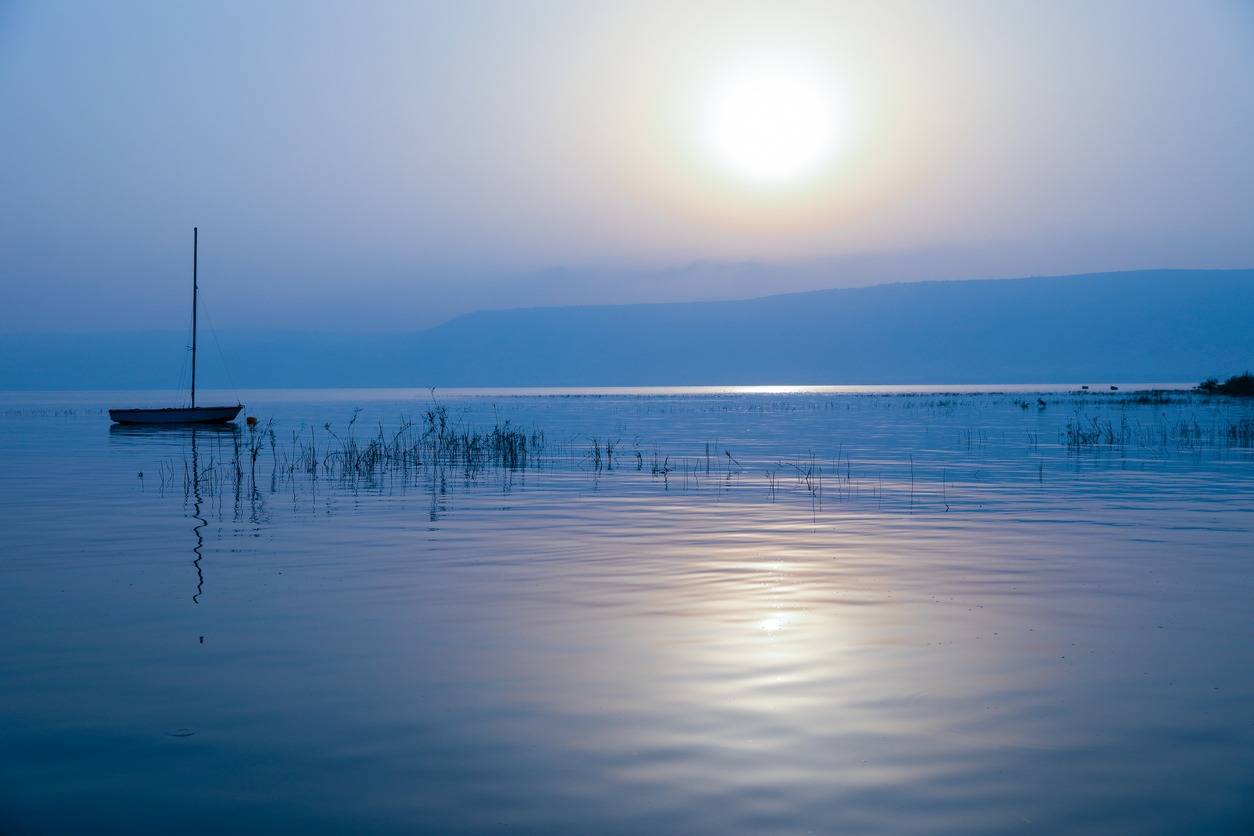
Historical Places : Sea of Galilee

Almost everybody has heard of the Sea of Galilee; especially Christians. It would be no surprise if most people who profess to be believers in Jesus Christ have this place on their list of dream travel destinations.  Some of the apostles were fishermen by occupation and they made their living by fishing in the Sea of Galilee. 

But would you believe it? In 2010, fishing was banned in the Sea of Galilee. The Israeli government stated that chronic over-fishing had severely depleted stocks. The ban was to be in effect for 2 years. 

In 2013, they dumped several thousand fish into the lake. The type of fish were tilapia and silver carp which were expected to increase the lake’s biodiversity and clear its waters of toxins. In 2020 it was reported that the lake (sea) had dried up because of a drought; and then it swelled up because the drought was followed by wet winters. Per a report dated April 15, 2022, Israel was going to give the Sea of Galilee an “extreme makeover” by filling the lake with excess output from desalination plants.

Image credit: Fishing in the Sea of Galilee | Israel Inside Out 

It's a technicality but the Sea of Galilee is not really a sea. It's a lake; a freshwater lake. Israel's largest freshwater lake to be precise.  It is also known by the following alternate names:

• Lake Tiberias
• Sea of Tiberias
• Lake of Gennesaret
• Lake Kinneret
• The Kinneret

FUN FACT: In ancient times. there were three (3) types of fish mainly caught by fishermen: sardines; barbels; and musht or tilapia (the 'Galilean tilapia' is known today as “St. Peter’s Fish”).

It's 2022. Fishing is being allowed in the Sea of Galilee. The original St. Peter’s fish in the Sea of Galilee cannot be found anymore. However, there are 18 species of fish indigenous in the Sea, which includes tilapia, sardine, and catfish.


Thursday, May 20, 2021

Bible Study: 7 Major Themes of the Book of Revelation

The overall theme of Revelation is TIME. 

The number 7 was used often in Revelation. There are more than 7 themes in Revelation, however these are the major themes.


1) Crown of life (Rev 2:10)

The saints who remain faithful until the end will receive a “crown of life”.


2) War in heaven (Rev 12:7)

The “war in heaven” is a spiritual war for our souls.  Satan does not want the faithful to be saved.


3) Lamb of God (Rev 5:12) is the Alpha and Omega ( Rev 21:6 )

The “Lamb of God” is Jesus Who was “slain”.  Jesus died for us.  He has the power over TIME.  The “Alpha and Omega” means He is the beginning and the end of TIME.


4) The Harvest   (Rev 14:15)

The “Harvest” is the final day when all on earth will be judged for their works; whether they were faithful or unfaithful.


5) A new heaven and a new earth (Rev 21:1)

The earth and heaven we now know will be destroyed.  A “new heaven” and a “new earth” will be the new home for the faithful.


6) Tree of life (Rev 22:2)

Jesus promised us eternal life.  The leaves on the “tree of life” are for healing.  Whoever eats of the tree can live forever.  But they have to be in heaven because that’s where the tree is.  Only the faithful will be in heaven.


7) JESUS IS COMING AGAIN! (Rev 22:12)

The faithful are in the church of Christ.  The church is the “bride of Christ”.  Jesus promised He would come again for His bride.  The church will be glad when Jesus comes!


(Image credit: The map of the 7 churches was found at Wikipedia, the free encyclopedia: Seven churches of Asia.)


* * *

If You Liked This, You Might Also Like:

The Major Themes of Genesis

The Book of Exodus

The Book of Numbers

Book of Deuteronomy


Original Source

The Book of Revelation in Art


https://foxmarksatx.tumblr.com/post/651751591768096768/the-woman-and-the-dragon-revelation-1214


https://foxmarksatx.tumblr.com/post/651751638924673024/the-seven-eyed-seven-horned-lamb-from-the-book-of

Sponsors