Showing posts with label ancient kingdoms. Show all posts

Thursday, June 11, 2026

Dangun and Gwanggaeto the Great of Goguryeo ~ Legend and History of Ancient Korea

The stories of Dangun and Gwanggaeto the Great are two of the most important narratives in ancient Korean history.  However, they come from very different traditions—one is legendary and mythological, while the other is historical.

{NOTE:  Dangun is a legendary figure whose existence is not historically verified, while Gwanggaeto the Great was a documented historical king of Goguryeo. This distinction is important to understand the difference between Korean mythology and recorded history.}

Dangun
IMAGE CREDIT: WooKong. “The First Korean - Dangun Wanggeom Myth.” YouTube, 15 Feb. 2021, https://www.youtube.com/watch?v=wTzIK9z1ZYM

Dangun: Founder of the First Korean Kingdom

Dangun is the legendary founder of Gojoseon, traditionally considered the first Korean kingdom.

The Legend

According to the medieval Korean text Samguk Yusa:

  • The heavenly prince Hwanung descended from heaven to Mount Taebaek with 3,000 followers.

  • A tiger and a bear prayed to become human.

  • Hwanung gave them garlic and mugwort and instructed them to stay in a cave for 100 days.

  • The tiger gave up, but the bear endured and transformed into a woman called Ungnyeo.

  • Ungnyeo later married Hwanung and gave birth to Dangun.

  • In 2333 BCE, Dangun founded Gojoseon and became its first king.

Significance

The Dangun story symbolizes:

  • The divine origin of the Korean people.

  • The union of heaven and earth.

  • The transition from tribal societies to civilization.

Today, many Koreans view Dangun as a cultural ancestor rather than a strictly historical figure.

Gwanggaeto the Great of Goguryeo

IMAGE CREDIT (Public Domain): Gwanggaeto the Great of Goguryeo

Gwanggaeto the Great: Warrior King of Goguryeo

Gwanggaeto the Great (374–413 CE) was a real historical ruler and one of Korea's most celebrated kings.

His Rise to Power

  • He became king of Goguryeo in 391 CE.

  • At the time, Goguryeo faced threats from neighboring kingdoms and nomadic peoples.

Military Achievements

Gwanggaeto launched numerous military campaigns that greatly expanded Goguryeo's territory:

  • Defeated the kingdom of Baekje and captured many fortresses.

  • Extended influence over much of Manchuria.

  • Subdued tribes such as the Khitan and other northern peoples.

  • Sent forces to aid Silla against invasions from Wa (often associated with ancient Japan) and allied forces.

  • Built Goguryeo into the largest state on the Korean Peninsula and surrounding regions.

The Gwanggaeto Stele

One of the most important records of his reign is the massive Gwanggaeto Stele, erected by his son, Jangsu, in 414 CE.

The inscription praises Gwanggaeto's victories and remains a crucial historical source for East Asian history.

Why He Is Called "The Great"

Few Korean rulers have received the title "The Great." Gwanggaeto earned it because:

  • He dramatically expanded Goguryeo's territory.

  • He strengthened royal authority.

  • He established Goguryeo as a major regional power.

At its height under Gwanggaeto and his son Jangsu, Goguryeo controlled territory stretching from northern Korea deep into Manchuria.

Legend vs. History

Dangun

Gwanggaeto the Great

Mythological figure

   Historical king

Founded Gojoseon (traditionally 2333 BCE)

   Ruled Goguryeo (391–413 CE)

Associated with creation myths

   Documented in historical records

Symbolic ancestor of Korea

   Military conqueror and empire builder

Story involves gods, a bear, and a tiger

   Known through inscriptions & chronicles


Together, Dangun represents Korea's legendary beginnings, while Gwanggaeto the Great represents one of the high points of Korea's ancient historical power.

{Dear reader: This article was prepared with the assistance of ChatGPT (OpenAI) and edited for publication.}

ADDITIONAL REFERENCES:

nonoumasy. “Gwanggaeto the Great Biography.” HistoryMaps, https://history-maps.com/people/gwanggaeto-the-great. Accessed 11 Jun. 2026.


“King Gwanggaeto the Great.” NamuWiki, https://en.namu.wiki/w/%EA%B4%91%EA%B0%9C%ED%86%A0%EB%8C%80%EC%99%95. Accessed 11 Jun. 2026.

Julia Dzhak. “King Gwanggaeto - Korea’s Great Conquer.” Warhistoryonline, 29 Apr. 2016, https://www.warhistoryonline.com/ancient-history/king-gwanggaeto-the-great-conquer.html.

Gods and Monsters. “Dangun: The Divine Founder of Gojoseon in Korean Mythology.” Gods and Monsters - Mythology and Wonder, 10 Jul. 2024, https://godsandmonsters.info/dangun/

**

You Might Also Like:

(FYI. Not AI-generated. Just me having fun blogging!)


*

Tuesday, August 26, 2025

Joie de Vivre's Ancient History Blog Posts Roundup!

Do you appreciate the value of history? Especially ancient history? There is a wonderful website called Ancient History Encyclopedia. The vision statement at their website clearly outlines their intent and purpose:
At Ancient History Encyclopedia we believe that ancient history is too important to be found in expensive books, on private homepages with a nationalist agenda, or less reliable Wikis. The internet is available in every country on earth, and it deserves reliable high-quality educational history information.”

They really do accomplish what they set out to do. They may not have set out to inspire me to do additional research and write blog posts about my findings, but they did! Below is a roundup of blog posts published at Joie de Vivre Magazine.

Do you like history?

Is there a favorite history blog or website you enjoy?

Hope you enjoy these posts.


***
Nimrod and the ‘Gate of God’

Ancient Kingdoms of Lydia and Persia

Who Were the Philistines?

Mark Antony and Antonia Fortress

Seven Wonders Plus One (or Two)

Did Alexander the Great Think He Was Great?

Alternate Names for the Dead Sea

♦♦♦


*

● Ancient History: African Kingdoms: Nubian Princesses


Wednesday, November 29, 2023

Ancient History : People and Places : Who Were the Philistines?


"Most Bible students know the menacing Philistines were the enemies of the Israelites. There were constant struggles for control of the land of Canaan (an older name for Palestine). A study, just a quick study, of the people of Philistia might lead one to conclude that … if they had not always been battling with the nation of Israel, they would have been at war with another group. They liked to fight!!

WHY? Because they could!!

The Philistines were skilled warriors; on land and at sea. In fact, they were once called Sea Peoples. Their navy consisted of fleets of the finest warships during that time, expertly manned by experienced soldier/seamen. As for their army? The infantry, i.e. trained foot soldiers, possessed superior weapons of iron and wielded them masterfully and mercilessly."

Good thing David was good with a slingshot!

Source: Ethiopian or Philistine? Am I a Dog?


Image credit: Gebhard Fugel [Public domain], via Wikimedia Commons


* * *

Friday, December 18, 2020

Bible Study: The Book of Exodus

The Book of EXODUS focuses on Israelites multiplying and spreading in the land of Egypt resulting in the Egyptians oppressing them with harsh labor due to Pharaoh’s fears of the tribes attempting to oppose him because of their increasing number of people. Pharaoh was so scared that he made an order to throw every Hebrew baby boy in the Nile River,but he allowed girls to live.

Moses was born a Hebrew and because of Pharaoh's order, his mother, Jochebed hid Moses for three months. When she could no longer do this, she then placed him in a papyrus basket and set it in the Nile River. Moses' sister, Miriam, carefully watched to see what would happen to him when Pharaoh's daughter saw him. Although he was identified as a Hebrew baby, Pharaoh's daughter took him to be her own son. Miriam suggested that she could find a Hebrew woman to nurse the child and she went and got Moses' mother.

Moses was raised as a part of Pharoah's family and lived in Egypt for 40 years. One day, he murdered an Egyptian who was mistreating one of the Hebrew slaves. The next day he discovered that his act was not a secret, so he ran away to Midian. There he lived as a shepherd, married, and had children. A life changing pivotal point in Moses' life occurs on Mount Horeb where Moses encounters a flaming bush that was not being burned by the fire. God spoke to Moses from the bush. God said He has heard their cries of agony from His people and Moses would be sent to deliver them. Moses was chosen to lead the Israelites out of Egypt to a land flowing with milk and honey called Canaan.

Listen to the Book of Exodus online free.


* Important Events in the Book of Exodus

Friday, January 10, 2020

Ancient History : People and Places : Nimrod and the ‘Gate of God’

If you come from a Judaeo-Christian background, then you might be familiar with the story of Babel because you were probably taught about it as a child. If you are unfamiliar with the biblical account, it tells of the time when everyone on earth all spoke the same language but God confused the languages. Why? Because there was a king who was trying to build a tower to reach heaven, where God lives. 
This ambitious and over-reaching endeavor was displeasing and as a punishment, God confused the languages of the people. This lack of communication prevented the laborers from working together and completing the building project. The unfinished structure is often referred to as the tower of Babel and symbolizes human pride and rebellion. The entire account of this event is all of nine (9) verses. You can read it in the Book of Genesis, Chapter 11, verses 1 through 9.


If you believe that Babel existed, then you might also believe that there was a king who angered God.
Now about that king. What was his name?
NIMROD
Scholars are in disagreement as to the identity of Nimrod. Some say he was Sargon the Great. Others say he was an Assyrian king, Tukulti-Ninurta I. Others speculate that he could have been Amenophis III, an Egyptian leader. Yet another group believes that he was Merodach-Baladan, a man who insisted on being king of Babylon, however, he never achieved his ambition.
The biblical record identifies Nimrod as the son of Cush, the grandson of Ham, and the great-grandson of Noah. He is described as “mighty” in two instances: “a mighty one on the earth” and “the mighty hunter before the Lord”. Furthermore, the Bible account states: “And the beginning of his kingdom was Babel and Erech and Accad and Calneh, in the land of Shinar.”  Shinar, the land of Southern Mesopotamia, became known as Babylonia.

Content first published at Blogjob.com on Jun 5, 2017.  Site shut down.

* * *
Other Posts in This Series:

♦  Related Links, Tweets, and Suggested Books and Literature:


  • What is a Universal Language of Light?

  • All Those “ites”


  • Friday, November 29, 2019

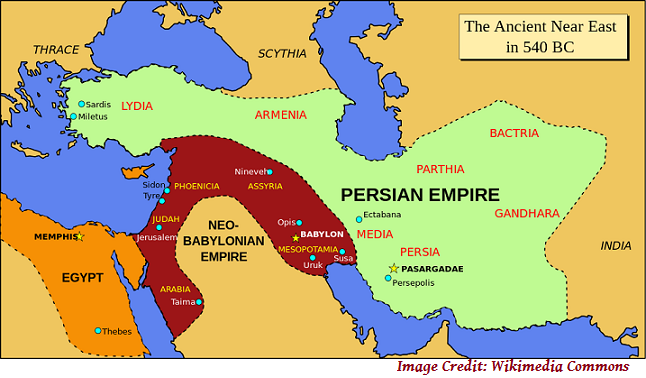
    Ancient History : Ancient Kingdoms : Lydia and Persia

    ♦ Quick history lesson. Hope you found it useful.  Learning never gets old.  Agree? 

    • The last king of Lydia was Croesus (560–546 B.C.). Some records describe the assets of his kingdom as “proverbial wealth” or “legendary wealth”.
    • "... the ruler who took the place of Croesus, is really the one who provided this kingdom with “true wealth”. Here are two interesting summaries of his empire."

    The article below shares a few quick facts about Lydia, an ancient kingdom of Central Asia Minor (modern-day Turkey).


    Sponsors