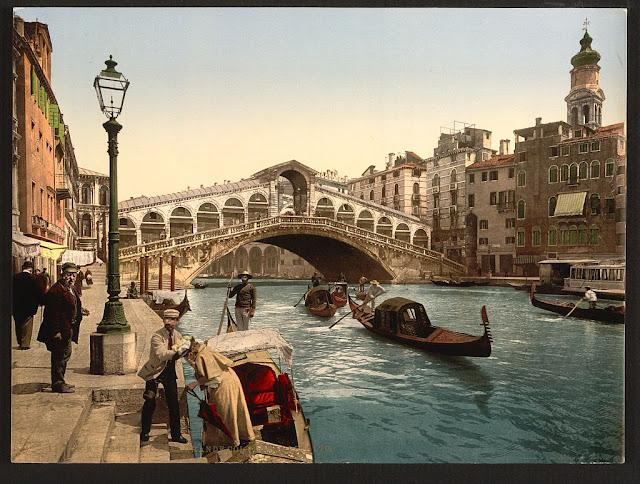
Have you always wanted to visit Venice?
Wouldn't it be even more interesting to travel back in time and visit 19th century Venice?
You can do so through this wonderful collection of photographs.
Welcome! Joie de Vivre Magazine (JDV) is a freestyle blog and presents content covering varied topics, e.g. art, psychology, culture, science, education, history, entertainment, and opinion pieces; along with curated content from around the web. Interesting, informative, entertaining, fascinating and fun! Experience my joie de vivre. Please visit often!

Succulents are plants that store extra water in their leaves, stems, or roots, allowing them to survive in dry or unpredictable climates. They come in many forms—from tiny stone-like Lithops to towering baobab trees—and make up roughly 3–5% of all flowering plants. Their defining trait is water storage, which lets them thrive in environments where many other plants cannot. (REF: British Cactus and Succulent Society)
Short answer: They can be—but it depends on how they’re grown, sourced, and used.
Below is a breakdown of the environmental benefits and concerns, based on current research.
Water efficiency
Succulents use far less water than traditional garden plants. Some need only 1–2 ounces per week, compared to several gallons for other species. This makes them excellent for drought-prone regions and water conservation efforts. (REF: shunwaste.com)
Climate resilience
Their drought tolerance and ability to store water make them valuable models for adapting agriculture and landscaping to climate change. They can help maintain greenery in increasingly arid environments. In other words, they can be very eco-friendly. (REF: cactusandsucculents.co.uk)
Ecosystem support
In their native habitats, succulents provide food, shelter, and water for animals, especially in deserts where resources are scarce. Their fruits help with seed dispersal and support biodiversity. (REF: cactusandsucculents.co.uk)
Overharvesting and habitat loss
Some succulents—especially rare cacti—are illegally collected from the wild, threatening species already at risk of extinction. (REF: Oxford Academic)
Carbon footprint from global trade
The booming popularity of succulents means many are shipped long distances, increasing carbon emissions. (REF: shunwaste.com)
Invasive potential
Certain succulents can become invasive when introduced outside their native range, disrupting local ecosystems. (REF: New Phytologist)
Soil degradation
Overharvesting wild plants can damage fragile soils and lead to erosion. (REF: shunwaste.com)
They are environmentally friendly when:
They are harmful when:
Succulents are adaptation champions, but like any trend, sustainability depends on responsible choices.
I don't have a green thumb. But if I ever own a home, I'd like to have a garden and want to know what the best flowers and plants are to grow. Succulents are good for indoors or outdoors. To learn more, do additional research on eco-friendly succulents and how to grow them sustainably.

Found this image on a Tumblr blog. When I did additional research, the findings indicated that“Pajau Yan” as described doesn’t appear in documented Vietnamese folklore or credible sources; however, similar motifs appear in the well-known Vietnamese moon goddess traditions (e.g., Hằng Nga/Chang’e) and broader Southeast Asian folklore, which can enrich your narrative while grounding it in documented mythology (see sources cited):
Pajau Yan is the Vietnamese Goddess of Healing and Good Fortune, revered as a luminous lunar spirit who dwells on the shimmering moon and guides souls with her sacred Flowers of Transition as they travel from life into the underworld. In many Asian traditions, the moon is more than a celestial body — it is a sacred realm inhabited by divine beings who influence earthly life and the spirit world alike, and Vietnamese folklore vividly reflects this belief system. The beloved Vietnamese moon goddess Hằng Nga, for example, is celebrated during the Mid-Autumn Festival; she is often associated with beauty, festivity, and harmony, and her presence on the moon symbolizes peace and reunion among families on Earth, illustrating how lunar deities bridge cosmic and human realms. (Gods and Demons Wiki)
In some folk tales, the moon also hosts other figures such as Cuội, a man who flew there alongside his magical banyan tree, and the Jade Rabbit, an immortal companion often depicted as a helper or symbol of selflessness and longevity — motifs that echo the idea of mystical moon dwellers aiding humanity. (senorganicsmallplate)
Within the broader tapestry of Vietnamese belief, female deities often embody nurturing, healing, and protective qualities; for instance, mother goddess traditions (Đạo Mẫu) emphasize divine feminine figures who intercede for good health, abundance, and transition between life stages. (Facebook) Pajau Yan’s role in guiding the dead with flowers resonates with these themes of compassionate guidance and renewal, reflecting humanity’s ancient hopes that life’s ending is not a final loss but a sacred transformation under the watchful grace of benevolent spirits.
“Hằng Nga.” Gods and Demons Wiki, fandom.com/wiki/Hằng_Nga. Accessed 8 Jan. 2026. (Gods and Demons Wiki)
Why Do Mr. Cuoi, Hang Nga And Jade Rabbit Live On The Moon? senorganicsmallplate.com/trung-thu-post/why-do-mr.-cuoi%2C-hang-nga-and-jade-rabbit-live-on-the-moon%3F. Accessed 8 Jan. 2026. (senorganicsmallplate)
Discover Vietnam’s magical Mid-autumn Festival. Vietnam.travel/things-to-do/vietnams-magical-mid-autumn-festival. Accessed 8 Jan. 2026. (Vietnam Tourism)
“Đạo Mẫu (Way of the Mother).” Vietnam Centre, Facebook, 2.5 years ago. (Facebook)
~ Do You Remember Humphrey Bogart?— My Fox Nooze (aka Joie de Vivre Magazine) (@FoxMarks_ATX) March 5, 2020
~ Do you have a #favorite #Bogie movie?
~ Would you #bingewatch old #Bogart flicks?
https://t.co/rRIMlKtlM6 @cmoneyspinner #oldmovies #Hollywood #Hollywoodlegends #entertainment @ClassicMovieHub pic.twitter.com/lucy1kzNAc
***
Not Uniformly Electric Blue: The real Nymphaea caerulea—sometimes marketed as “electric blue lotus”—doesn’t normally have neon-blue flowers. Authentic petals show a gradient from pale lavender toward deeper violet-blue at the edges and have a faint honeyed scent, while extremely bright blue hues in products often indicate dye or mislabeling.
Distinct from Sacred Lotus: The blue lotus lily is botanically distinct from the sacred lotus (Nelumbo nucifera). The sacred lotus often has pink or white blooms, whereas the blue lotus (N. caerulea) is a water lily species native to the Nile River basin.
Alkaloid Content Varies Widely: Studies and lab testing show that many commercially sold “blue lotus” products may lack authentic alkaloids (like nuciferine and apomorphine), with significant variation depending on origin and processing, so identifying the correct species and sourcing is important.
The "Stealth flower" photographed blooming at night near Loco, Oklahoma, by Linda Stokes is a Night-Blooming Cereus (Epiphyllum oxypetalum). Also known as "Queen of the Night," this rare, fragrant, white cactus flower blooms only for one night, typically opening around dusk and wilting by dawn.
Alibaba. “How to Choose the Best Blue Lotus Flower Dried: A Complete Buyer’s Guide.” Alibaba.com Product Insights, 2026, https://www.alibaba.com/product-insights/how-to-choose-the-best-blue-lotus-flower-dried-a-complete-buyer’s-guide.html.
Alibaba. “How to Choose Real Blue Lotus: A Complete Buyer’s Guide.” Alibaba.com Product Insights, 2026, https://www.alibaba.com/product-insights/how-to-choose-real-blue-lotus-a-complete-buyer’s-guide.html.
Articles of Interest for Aspiring Photographers:
**
Artist Barnali Bagchi (aka moonbeam1212) has so many charming, delightful, fanciful, mesmerizing pieces to choose from, it was difficult for me to narrow down a “representative sample”. These two are inadequate to represent but they are a delicious enough sampling to whet your appetite and make you crave for more. What's not to love about her art?
Shared via Pinterest: http://ift.tt/2gv8fWW
(Question) What does art mean to you?
(Answer) “To me art means beauty. … If I remember correctly, it was the poet Keats who said "A thing of beauty is a joy forever." I feel the "beauty" and "joy" he is alluding to can be encapsulated in one word - art.”
"Artist Kohn established himself in the late Forties with his dynamic pulp covers, fronting such titles as the venerable Amazing Stories. ...The piece was used as a cover for a Whitman “Authorized TV Adventure” book called The Munsters and the Great Camera Caper, written by William Johnson ."